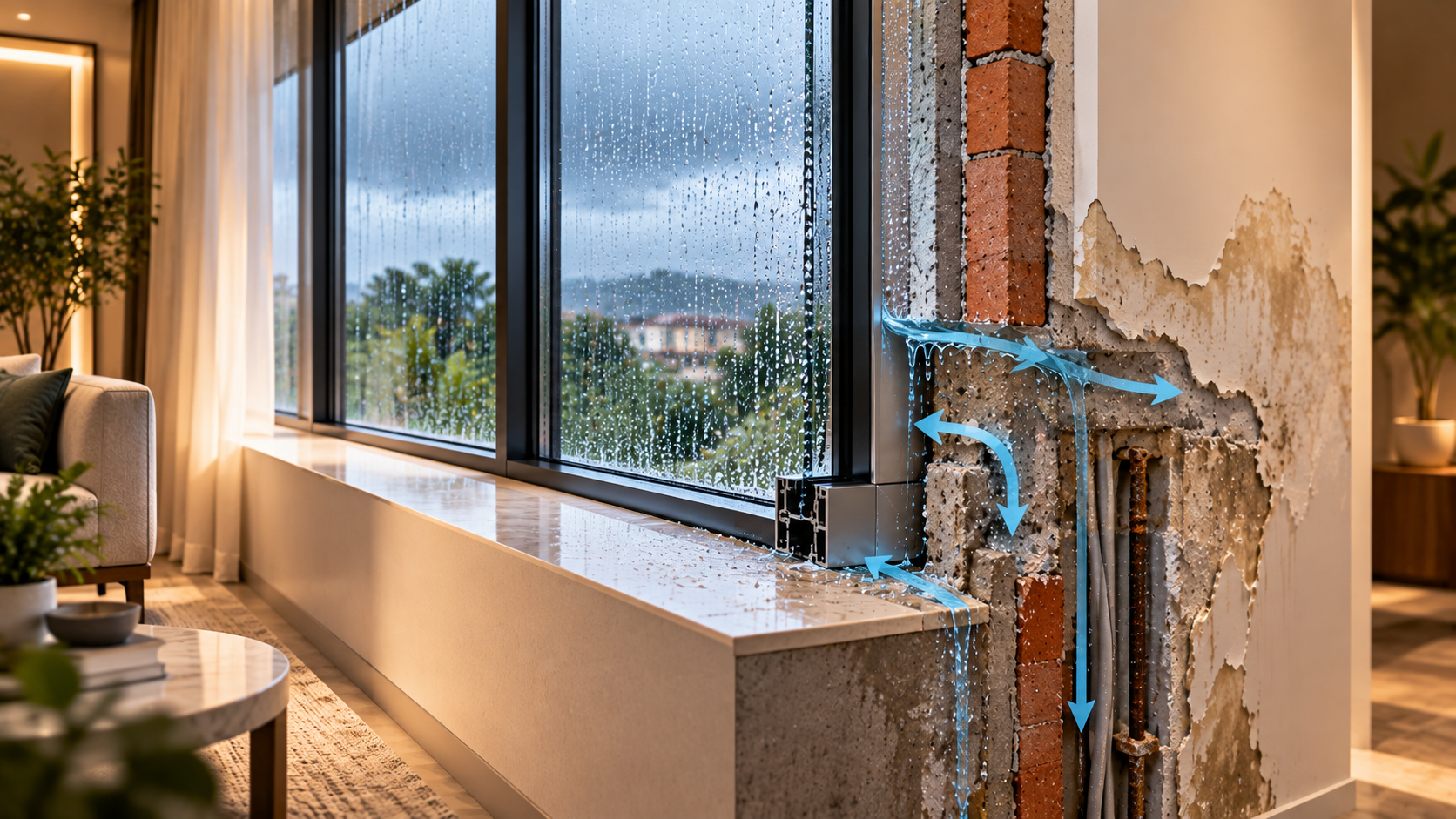
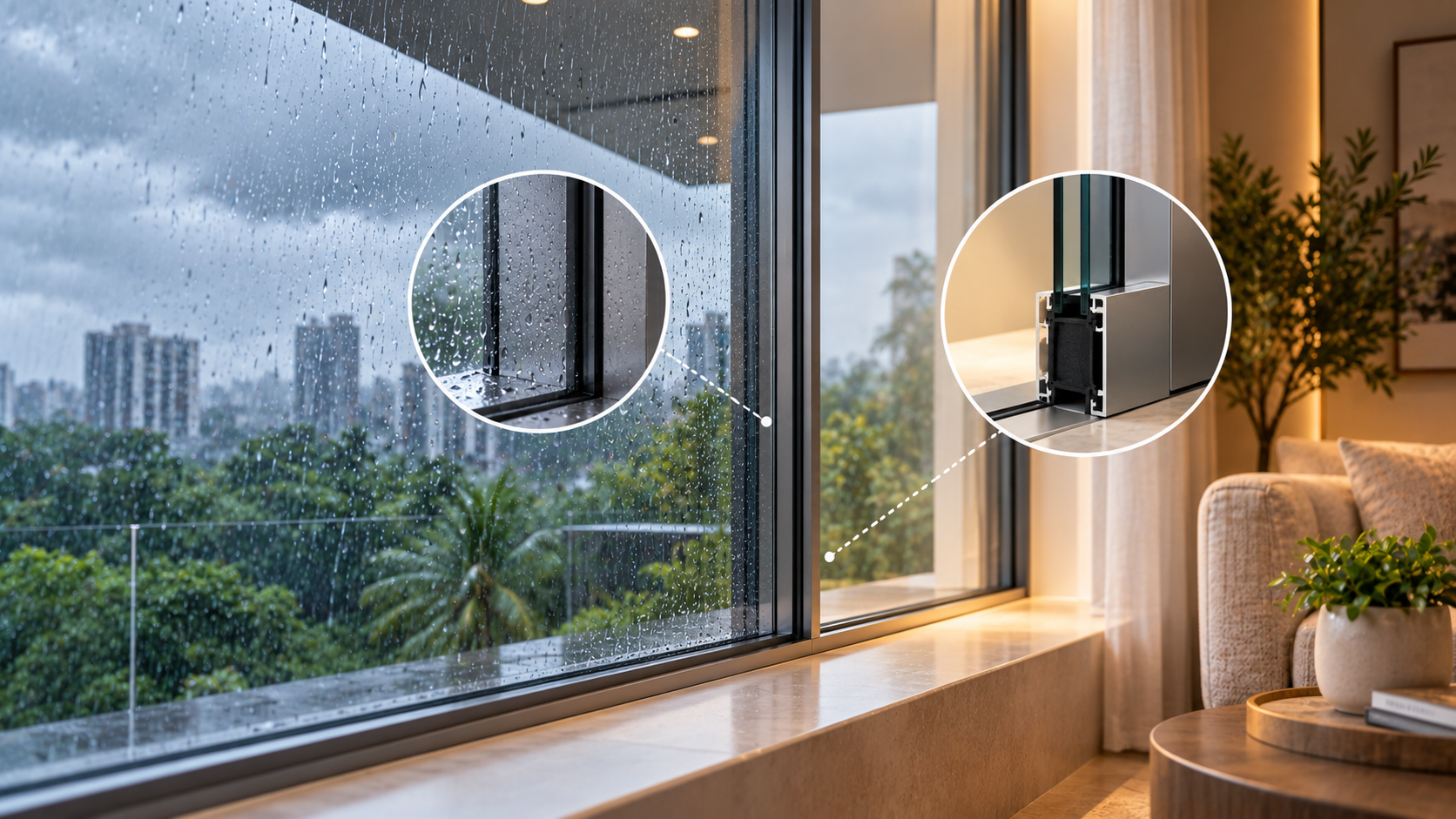
Window complaints do not peak when the monsoon begins. They peak roughly two months in, and in most of India that means October.
The reason is cumulative. June and July do the damage. October is when the damage becomes visible.
Why October Specifically
Three things line up by the middle of the season.
The masonry around your windows has been wet for weeks and has stopped absorbing anything further, so water that used to disappear into the wall now runs somewhere visible. Gaskets that were already hardening have spent two months compressed and soaked, and have lost the elasticity that made them seal. And October frequently delivers the season’s strongest wind alongside heavy rain, which is the combination that finds every weakness at once.
A window that survived June comfortably can fail in October without anything new having gone wrong.
What Typically Fails
The failures are predictable, and they are rarely the frame itself:
- Gaskets that have lost compression, leaving a gap the shutter can no longer close against.
- Weep holes blocked by silt, which the first heavy rains washed into the track and the later ones packed solid.
- Frame-to-wall sealant that has cracked, usually along the top edge where UV exposure is highest.
- Worn rollers and misaligned shutters, which stop the window from pulling tight against the frame when locked.
- Locking points that no longer engage fully, meaning the window is closed but not sealed.
- Sealant at the sill that has debonded, letting water track backward underneath the frame where it is invisible from inside.
What You Can Do Right Now
Mid-season checks are worth doing, and none of these need a technician:
- Pour a cup of water into the outer track and watch whether it drains. If it pools, the weep holes are blocked.
- Clear the drainage holes with a thin wire, then flush the track again to confirm flow.
- Run a finger along the gasket and feel for hardened, cracked or flattened sections.
- Close and lock every window fully, then check whether the shutter sits tight against the frame all the way around.
- Inspect the outer perimeter sealant for cracks or sections lifting away from the wall.
Repair Now or Replace Later
Gaskets, sealant and hardware are replaceable, and doing that mid-season will get most windows through to October.
Replacement becomes the better decision when the frame itself has shifted, when there is no drainage designed into the profile at all, or when the same window has leaked in three consecutive seasons. At that point, repairs are buying time rather than solving anything.
Final Thought
October failures are not sudden. They are the visible end of a process that started in June.
The useful thing about knowing this is that mid-season intervention still works. A blocked weep hole cleared this week is a leak that does not happen next week, and that is a much better position than discovering the problem through a damp wall in September.